
GMet Goes To The Court Of Public Opinion After Overcharging Fees For A 7-Page RTI Response
Story by: The Treasure News Desk
Read time: 7 mins
If access to public information is meant to strengthen accountability, then the price of obtaining it should not become the story.
Yet that is precisely where the Ghana Meteorological Agency (GMet) finds itself.
Days after the Treasure publicly questioned a GH¢10,400 charge for responding to a Right to Information (RTI) request that ultimately comprised a seven-page document and one Excel spreadsheet, the agency has launched a public defence of its decision through a three-page press statement.
The statement follows comments made by Benjamin Tenkorang, Editor of The Treasure News Agency, on the Joy SMS on Wednesday, June 17, as part of the Corruption Watch segment examining compliance with Ghana’s Right to Information Act.
Rather than respond to the central legal question raised during the discussion, whether the fees charged comply with the applicable RTI fee schedule, GMet’s statement seeks to justify the amount by describing the request as involving specialised meteorological data spanning ten years and requiring extensive technical work.
The request sought historical meteorological data covering rainfall and temperature records between 2016 and 2025, together with information on the methodologies used to measure rainfall and identify annual rainfall and temperature extremes. The applicant requested ‘existing’ information held by the agency under Ghana’s Right to Information Act (Act 989).
Specifically, the applicant requested;
- The total recorded annual rainfall (in millimetres) in Ghana for each year from 2016 to 2025.
- Average annual rainfall volume recorded for each year stated in Point 1.
- The method used for measuring the rainfall volumes for each year stated in Point 1.
- The locations (region, district or town) with the three lowest annual rainfall volumes recorded for each year stated in Point 1.
- The locations (region, district or town) with the three highest annual rainfall volumes recorded for each year stated in Point 1.
- Duration of the rainfall season for each year stated in Point 1, indicating the number of rainfall days recorded per year.
- Average annual temperature recorded for each year stated in Point 1, indicating the average minimum (low) and maximum (high) temperatures.
- The locations (district or town) with the three highest annual temperature recorded for each year stated in Point 1.
- The locations (district or town) with the three lowest annual temperature recorded for each year stated in Point 1.
- Duration of the Harmattan season for each year stated in Point 1, including the number of days the Harmattan conditions were recorded per year.
After the statutory period for responding to the request elapsed without a decision, The Treasure exercised its right under the Right to Information Act by applying for an internal review. It was only after the internal review process had been initiated that the Ghana Meteorological Agency (GMet), in a letter signed by its Director-General, Dr. Eric Asuman, informed the applicant that the request was being processed and that access to the requested information would be subject to the payment of charges.
In communicating the charges, GMet stated that “ in accordance with the Right to Information Act, 2019 (Act 989), and the applicable Fees and Charges (Miscellaneous Provisions) Act of Parliament, access to the requested information will attract fees, which are determined based on the specific parameters requested, the number of stations , and the period of data required.”
Subsequently, GMet issued an invoice demanding payment of GH¢10,400 for access to the requested information. The Treasure sought clarification on how the charges had been calculated, including the number of pages involved. In response, GMet confirmed by email that the records to be released comprised only seven pages and one Excel spreadsheet.
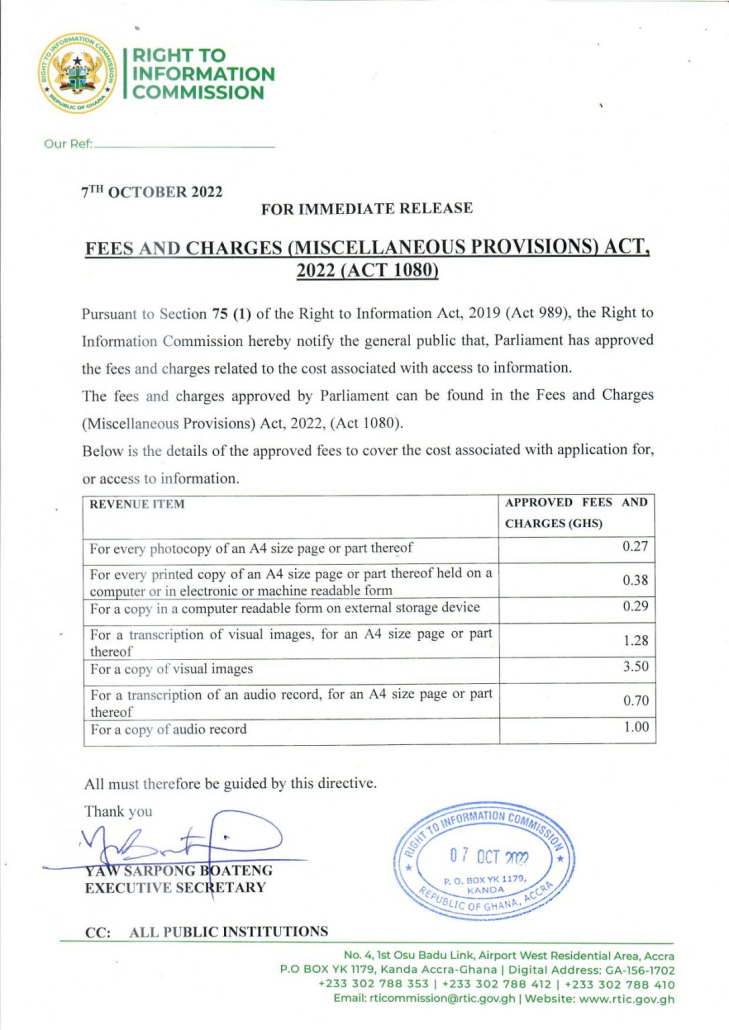
Under the applicable RTI fees regulation, however, charges for access to information are tied to the cost of reproducing the records; including the number of pages supplied, rather than the scope or parameters of the information requested. Instead, GMet calculated its fees based on multiple meteorological parameters, the number of weather stations involved, and the ten-year period covered by the request. A scrutiny of the Fees and Charges (Miscellaneous Provision) Act 2022 (Act 1080) shows that we are supposed to pay not more than GHS5 for the seven-paged word document and the excel sheet.
The Treasure contends that the GMet’s approach is inconsistent with the fee framework governing requests made under the RTI law and effectively imposes charges beyond what the legislation permits.
Curiously, GMet’s public statement devotes considerable space to explaining how it calculated the GH¢10,400 fee. It states that responding to the request required technical officers to retrieve archived datasets, validate their integrity, conduct quality assurance checks, analyse meteorological records from 22 synoptic weather stations across the country over a ten-year period, and prepare what it described as a customised report for the applicant.
“Following a technical assessment, the Agency determined that fulfilling the request would require the technical officers to retrieve archived datasets, validate their integrity, perform quality assurance checks, analyse information of meteorological records from twenty-two (22) synoptic weather stations nationwide over a ten-year period and prepare a customised report for the client.”
However, in focusing on the work it says was required, GMet omits two facts that lie at the heart of this dispute.
First, the agency’s own response to the RTI request indicated that the information to be released comprised just seven pages and one Excel spreadsheet.
Second, contrary to the impression created by the press statement, the request was for access to ‘existing’ information held by the agency under the Right to Information Act.
Those omissions matter because the argument is not whether public institutions may recover reasonable costs for providing access to information. Rather, it is whether the fees imposed in this instance were authorised under the legal framework governing RTI requests.
Zakaria Tanko Musah, a private legal practitioner and lecturer explained during the June 17th 2026 Corruption Watch show that: “Section 75 of the Act, which deals with fees and charges, is quite clear that fees are not required to be paid in certain circumstances, including where the requested information is in the public interest. Technically, the information that was requested falls within the category of information that should already be available on the institution’s website because it is of public interest. When it comes to access to information, the RTI law overrides any other law.”
A week after the programme aired, the issue resurfaced on another edition of Corruption Watch on Adom FM. During the discussion on Friday, June 27th 2026, Stephen Owusu, Director of Legal Department, Right to Information Commission (RTIC) reaffirmed the primacy of the RTI Act, citing Section 85. He stated: “If you had any law that deals with the handling of information requested from your institution prior to or after the passage of the RTI Act by the Parliament of Ghana, note that Section 85 of the RTI Act has supremacy over any other law on the release of information.”
His remarks underscored the position that the RTI Act prevails over any conflicting legal or administrative provisions governing access to information held by public institutions.
The questions raised by the matter extend beyond a single request. Historical rainfall data is not merely an administrative record.
Recently, the Minister for the Interior, Muntaka Mohammed Mubarak, told Parliament that June 2026 recorded the highest rainfall ever measured in Ghana. Citing data from GMet, he said the country received 593.2 millimetres of rainfall during the month, surpassing the previous record of 420.6 millimetres set in 2002 and the 380.3 millimetres recorded in 2015.
Those figures are revealing. But they lack something. Against what baseline should Ghanaians assess claims about record-breaking rainfall, including the heavy rains that fell on Monday? Without access to historical meteorological data, it is difficult for the public, researchers, and journalists to independently verify such claims or place them in their proper context. This is why a request such as that by the Treasure for rainfall and temperature statistics over a 10-year period is very important.
Access to historical data enables meaningful comparisons, strengthens public understanding of extreme weather events, and promotes informed public debate grounded in evidence rather than official assertions alone.
Before GMet issued its public statement, The Treasure News Agency had already petitioned the Right to Information Commission (RTIC) to investigate the matter. The petition asks the Commission to determine whether the fees charged comply with the applicable legal framework governing RTI requests and whether the agency’s interpretation of the law is consistent with the constitutional right of access to information.
The Commission’s determination could clarify not only the lawfulness of GMet’s charges, but also the standards that all public institutions must apply when citizens seek information under Ghana’s Right to Information Act.

