
From Policy to People: How Ghana’s non-state actors are pushing a people-centred Energy Transition

Story by: Kate Larko Teye
Read time: 4 mins
Accra, Ghana – Ghana’s energy transition is no longer just a government-driven agenda. It is fast becoming a collective national movement shaped by civil society, communities, and researchers working together with policymakers.
This was the central message at a Civil Society National Forum on Energy Transition convened by the Ghana Energy Transition Consortium (GETC) in Accra where stakeholders gathered on 28th April 2026 to examine progress, challenges, and the role of civil society organizations (CSOs) in driving a just and inclusive transition.
The forum was on the theme: “The Role of CSOs in Advancing Ghana’s Energy Transition Agenda: GETC as an Enabler.”
Opening the forum, Chibeze Ezekiel, the convener of GETC, reflected on how far the conversation has come.
“When we started about five years ago, energy transition was little understood,” he said. “Today, civil society is responding, engaging, and encouraging each other to take action.”
He stressed that CSOs are no longer limited to holding government accountable but are actively contributing solutions and shaping the energy transition discourse.
Ghana’s energy transition framework
Recognising that the energy and transportation sectors are key areas in reducing emissions, the government of Ghana developed the National Energy Transition Framework, which is aimed at decarbonizing the energy sector.
It is described as “a long-term net-zero framework” for the period 2022-2070, and expected to complement existing efforts with new measures, such as increased renewable energy penetration, conversion of thermal plants to natural gas and the integration of nuclear power into the energy mix.
The framework projects to guarantee the best fuel supply security due to a diversified fuel mix, avoid an estimated 200MtCO2-eq of emission, provide access to and commercialization of the green trade market, and achieve universal access to electricity – 99.8% by 2030.
In addition, it forecasts to lower long-term cost of electricity generation to below 4.5cents/kWh, meet future electricity demand of 380,000 GWh (83GW install capacity) due to fuel switch, minimise energy-related indoor air pollution and its related illnesses, thereby avoiding up to 48,218 premature deaths, and lead to the creation of up to 1.4 million new job opportunities.
The achievement of all these forecasts rests on the government’s ability to raise the required estimated financing of about GHS6.289 trillion (or US$562 billion if converted at the Bank of Ghana’s end of April 2026 rate of 11.1900 cedis to a dollar).
Delivering the keynote address at April’s forum, Chris Nanabanyin Yalley, acting deputy executive secretary of the Energy Commission, laid out Ghana’s energy transition agenda within both global and local contexts.
“Ghana’s energy transition must be inclusive, transparent, and accountable,” he stated.
He noted that while global investments in clean energy now exceed $2 trillion annually, nearly 600 million people in sub-Saharan Africa still lack electricity, and about one billion lack access to clean cooking.
Meanwhile, Africa contributes less than 4% of global emissions yet bears a disproportionate burden of climate impacts.
“This means the transition here is not only about reducing emissions,” Yalley explained. “It is also about expanding access and transforming a system already under pressure.”
Yalley highlighted Ghana’s progress, including achieving about 90% electricity access and increasing investments in renewable energy. However, he cautioned that the transition must reflect existing realities.
“We are operating within constraints shaped by past investments and existing systems. If we ignore them, we risk setting expectations the system cannot meet,” he warned.
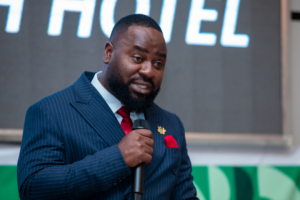
Mr. Yalley, acting dep. exec. secretary of the Energy Commission addresses the forum (Photo Credit: SYND)
He outlined key priorities such as expanding renewable energy to 10% by 2030, promoting solar mini-grids and rooftop solar, improving energy efficiency, and developing frameworks for electric vehicles.
Changing the game, demonstrating impact
There is growing recognition that a successful transition to a low-carbon economy must be inclusive, participatory, and responsive to the needs of all stakeholders.
The GETC, a coalition of CSOs working to advance a just and equitable energy transition plays a pivotal role in shaping discourse, influencing policy, and strengthening stakeholder engagement in Ghana’s energy sector.
So far, GETC says it has contributed to awareness creation, capacity building, and advocacy efforts aimed at ensuring that Ghana’s energy transition process is not only technically sound but also socially just.
Despite these efforts, gaps remain in coordination, stakeholder inclusion, and public understanding of the energy transition agenda. GETC identifies that CSOs, in particular, require strengthened platforms to engage government, private sector actors, and development partners in meaningful dialogue.
During the recent forum, CSOs demonstrated their growing influence not just as watchdogs, but as also solution providers.
From the Centre for Extractive and Development Africa (CEDA), Stephan Collins-Hespelt emphasized community engagement.
“We train communities and empower them to train others,” he said. “This ensures the transition is understood and owned at the grassroots level.”
Programs such as school quizzes, youth engagement initiatives, and research into green jobs are helping to build long-term capacity.
The Kasa Initiative also highlighted its role in coordinating over 200 CSOs and ensuring inclusion.
“We advocate for a just transition where no one, including persons with disabilities, is left behind,” a representative said.
Meanwhile, GreenFaith Ghana is leveraging religious platforms to drive awareness.
“We translate policy into moral language,” a representative explained. “Faith leaders can influence communities in ways policy alone cannot.”
Beyond advocacy, practical solutions were showcased.
Dream Renewable Energy highlighted its work in training youth in solar installation and deploying solar-powered systems in underserved communities.
“Capacity building is key,” a representative said. “We don’t just install; we train communities to sustain these systems.”
Their solar-powered clinics have improved healthcare delivery, while water systems have reduced waterborne diseases and eased the burden on women.
Similarly, ABANTU for Development emphasized gender inclusion.
“We ensure women are part of decision-making and benefit from climate solutions,” a representative stated.
Their work includes solar irrigation for women farmers, land restoration, and leadership training.
Opportunities and Risks
Providing a technical outlook, Dr Robert Sogbadji, deputy director for renewables and green emerging technologies at the Ministry of Energy and Green Transition, outlined both the opportunities and risks of Ghana’s energy transition.
He said energy transition allows to diversify energy sources, reduce costs over time, improve air quality, and create jobs.
However, he warned that the transition must be carefully managed.
“Over 60% of Ghana’s energy comes from gas. If we transition poorly, we risk energy shortages,” he cautioned.
He mentioned key risks as intermittency of renewable energy, high cost of battery storage, potential loss of oil revenue, stranded assets, and job losses in fossil fuel sectors.
On global dynamics, he pointed to contradictions in international commitments. “Countries claim to be transitioning yet return to fossil fuels during crises. We must plan based on our realities,” he noted.
He also raised concerns about food security. “If we turn farmlands into biofuel production, what will we eat?” he asked.
Other speakers stressed that the transition must not come at the expense of communities.
In addition, advocates highlighted the need to protect environmental and human rights, especially in mining areas.
“Yes, we need energy, but not at the expense of people’s rights,” one speaker emphasized.
Communities, they noted, are increasingly informed and using legal systems to demand accountability.
Bridging knowledge and action
The forum concluded with a high-level discussion featuring academia and policy experts. The panel reinforced the need for stronger collaboration between academia, civil society, and government to ensure evidence-based decision-making.
Mabel Acquaye of the Africa Centre for Energy Policy (ACEP), a panelist, delivered a critical reflection on the gap between research and policy implementation, noting that research must move beyond shelves into action.
“Academic findings should not remain buried in technical language; they must be translated into clear, practical insights that policymakers can use,” she emphasized.
As the forum closed, one message stood out: Ghana’s energy transition is not just about energy it is about people.
From community engagement to policy reform, from gender inclusion to technological innovation, the transition is being shaped at every level of society.
As Yalley noted in his keynote speech, collaboration will be key.
“We welcome engagement not just criticism, but contributions that help improve the system,” he said.
For Ghana, the path forward is complex, but with collective effort and inclusive action, the country is moving steadily toward an energy future that is cleaner, fairer, and truly transformative.
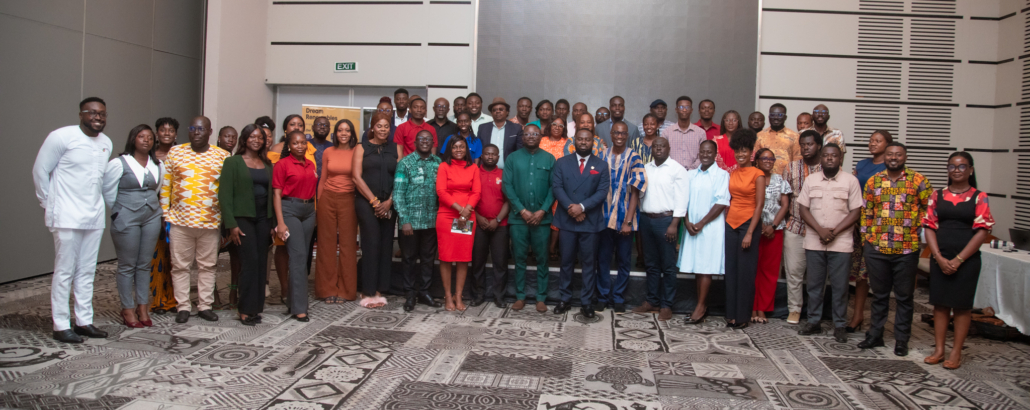
Group photo of forum participants (Photo Credit: SYND)


